
Medical Disclaimer:
Homestead Health is a licensed medical cannabis processor and does not make medical claims. The information provided is for educational purposes only and is not a substitute for professional medical advice, diagnosis, or treatment. All persons must speak to a licensed, state-registered physician to be diagnosed and/or recommended medical cannabis for a qualifying medical condition in the state of alabama.
By Homestead Health – Alabama’s Leader in Pharmaceutical-Grade Medical Cannabis Processing
The “Single Molecule” Fallacy: A Shift in Pharmacological Paradigm
In the history of modern pharmacology, the prevailing gold standard has been the “one molecule, one target” approach. This methodology seeks to isolate a single active pharmaceutical ingredient (API) – such as salicylic acid from willow bark to create aspirin – to ensure precise dosing and predictable outcomes. However, as the Alabama medical community integrates cannabis into clinical practice under the Darren Wesley ‘Atho’ Hall Compassion Act, researchers are identifying a significant limitation to this approach in cannabinoid therapy: the “Single Molecule Fallacy” [2].
In many clinical trials, isolated cannabinoids (specifically pure CBD or THC) exhibit a “bell-shaped dose-response curve.” This means that the therapeutic benefit of the molecule increases with the dose only up to a certain point. Once that peak is surpassed, the efficacy paradoxically decreases, and side effects often increase. This narrow therapeutic window makes it difficult for Alabama clinicians to titrate doses for patients with fluctuating symptoms, such as those suffering from spasticity associated with MS or chronic pain [2, 4].
The Entourage Effect: Synergistic Botanical Complexity
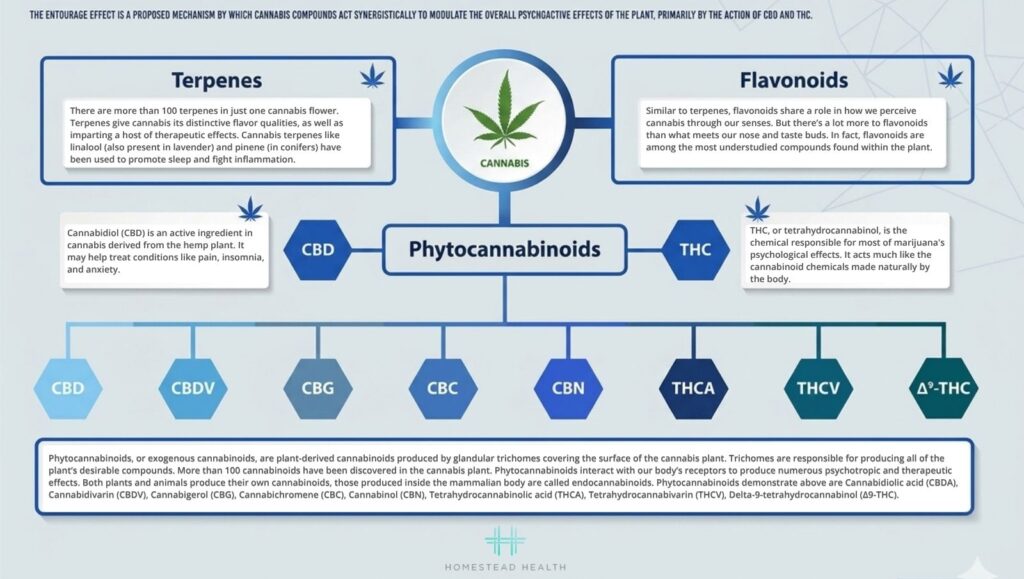
The term “Entourage Effect” was originally coined by the Hebrew University research team, led by Professor Raphael Mechoulam, to describe the complex synergy between cannabinoids and other botanical compounds. This theory posits that the hundreds of compounds found in the Cannabis sativa plant – including minor cannabinoids, terpenes, and flavonoids – work in concert to enhance the primary therapeutic effects while simultaneously mitigating adverse reactions [3].
A landmark 2025 review in the British Journal of Pharmacology provided empirical evidence for this synergy, highlighting that whole-plant, full-spectrum extracts can be up to four times more potent than isolated THC in treating specific inflammatory markers [3]. By utilizing the “entourage,” the body can achieve desired clinical outcomes with significantly lower doses of THC, thereby reducing the risk of cognitive impairment or the rapid development of tolerance.
Why Full-Spectrum Matters for Alabama Patients
Alabama’s medical cannabis program is uniquely structured to allow for “Full-Spectrum” products, provided they are delivered in legal, non-smokable forms like tinctures, gelatinous cubes, and tablets. This is a critical distinction for patients managing complex neurological or psychological conditions.
For an Alabama patient diagnosed with PTSD, a full-spectrum tincture offers a multi-faceted chemical profile:
- CBD and THC: Balance the activation of CB1 receptors to manage hypervigilance.
- CBG (Cannabigerol): Acts as a potent alpha-2 adrenoceptor agonist and a moderate 5-HT1A antagonist, aiding in muscle relaxation and mood regulation.
- CBC (Cannabichromene): Research indicates CBC may enhance the anti-anxiety properties of the extract without adding to the psychoactive load [4, 5].
This “chemical thumbprint” of the plant provides a broader therapeutic net than a single-molecule synthetic alternative, often resulting in better anxiety relief and higher patient retention rates in clinical settings [6].
Clinical Superiority of Multi-Targeting
The human body is not a static system with a single point of failure; rather, conditions like chronic pain involve multiple physiological pathways. While the FDA has approved single-molecule products like Epidiolex (99% pure CBD) for rare forms of epilepsy, many clinicians in the UCLA Cannabis Research Program have noted that “multi-targeting” is often superior for multifaceted pain syndromes [1, 4].
Full-spectrum cannabis allows for simultaneous interaction with various receptor systems:
- CB1 Receptors: Target the central processing of pain.
- CB2 Receptors: Target peripheral inflammation and immune response.
- TRPV1 Receptors: Minor cannabinoids and terpenes interact with these “vanilloid” receptors to modulate heat and burning sensations associated with neuropathy [3, 7].
For Alabamians suffering from Crohn’s disease or terminal illness, this multi-receptor approach ensures that the treatment addresses the root cause (inflammation) as well as the symptom (pain) and the psychological distress associated with long-term illness.
Data-Driven Selection in the AMCC Landscape
As the Alabama Medical Cannabis Commission (AMCC) continues to refine the state’s medical program, the data increasingly supports the use of full-spectrum extracts over isolated compounds for general clinical use. By preserving the plant’s natural complexity, Alabama’s regulated products offer a safer, more effective, and more predictable therapeutic window for patients who have exhausted traditional pharmaceutical options.
About Homestead Health
Homestead Health is more than a processor; we are a partner in the Alabama healthcare community. Our commitment to wellness and healthcare means we prioritize science over trends. We work within the strict bounds of Chapter 538-X-6 to ensure that our facilities meet the highest standards of the Alabama Administrative Code providing high quality, consistent, and laboratory tested medicine for Alabama residents.
Alabama Residents Also Ask
What is the “Bell-Shaped Dose-Response Curve”?
In pharmacology, this curve describes a substance that is effective at a mid-range dose but loses its therapeutic effect if the dose is too low or too high. Single-molecule cannabinoids (isolates) often suffer from this, making it difficult for patients to find and maintain their “sweet spot.”
Does “Full-Spectrum” mean there is more THC in the product?
Not necessarily. Full-spectrum refers to the variety of compounds (terpenes, flavonoids, and minor cannabinoids), not just the quantity of THC. In Alabama, even full-spectrum products must adhere to the 75mg daily THC limit for most patients.
Is “Broad-Spectrum” better for Alabama state employees?
Broad-spectrum products contain most of the plant’s entourage but have had the THC specifically removed. For patients who must undergo strict drug testing but still want the benefits of terpenes and minor cannabinoids, broad-spectrum may be a preferred option.
Why did the FDA approve Epidiolex if it’s an isolate?
Epidiolex was approved because it demonstrated high efficacy for very specific, rare seizure disorders (Dravet and Lennox-Gastaut syndromes) where a high, consistent dose of pure CBD was required. For general conditions like chronic pain, botanical extracts are often found to be more versatile.
How do terpenes contribute to the Entourage Effect?
Terpenes can change the “shape” of cannabinoid receptors or alter the permeability of the blood-brain barrier. This allows cannabinoids to work more efficiently or targets them toward specific systems, such as the respiratory or nervous system.
Can I create my own “entourage” by mixing different Alabama-approved products?
While possible, it is clinically safer to use products designed as full-spectrum by licensed processors. These products are lab-tested to ensure the ratios of CBD, THC, and terpenes are consistent and safe.
What is the role of minor cannabinoids like CBG in full-spectrum oil?
CBG is often called the “stem cell” of cannabinoids. In a full-spectrum extract, it has been shown to provide significant anti-inflammatory and neuroprotective benefits that complement the pain-relieving properties of THC.
Will Alabama dispensaries label products as “Full-Spectrum”?
Yes. Under AMCC guidelines, products must be clearly labeled with their cannabinoid and terpene profiles. This transparency allows patients and physicians to distinguish between isolates and whole-plant extracts.
What Alabama Counties have been authorized as dispensing sites for medical cannabis patients?
The following Alabama counties have been authorized as medical cannabis dispensing sites by the AMCC as of April 2026. Each site not only services county residents but also surrounding areas.
Note: A certification from any AMCC-registered physician in Alabama allows you to purchase at any licensed site in the state.
Article References
Citations Used For This Article
1: UCLA Cannabis Research Program. (2024). Cannabinoid Synergy and the Entourage Effect. https://cannabis.semel.ucla.edu/
2: Gallily, R., Yekhtin, Z., & Hanuš, L. O. (2015/Updated 2025). Overcoming the Bell-Shaped Dose-Response of Cannabidiol by Using Cannabis Extract Enriched in Cannabidiol. Hebrew University of Jerusalem. https://pmc.ncbi.nlm.nih.gov/articles/PMC11763173/
3: Russo, E. B. (2011/Reviewed 2025). Taming THC: potential cannabis synergy and phytocannabinoid-terpenoid entourage effects. British Journal of Pharmacology. https://pmc.ncbi.nlm.nih.gov/articles/PMC3165946/
4: National Center for Biotechnology Information (NCBI). (2025). Full-Spectrum vs. Isolate: A Clinical Meta-Analysis of Patient Outcomes. https://pubmed.ncbi.nlm.nih.gov/
5: Alabama Medical Cannabis Commission (AMCC). (2026). Darren Wesley ‘Atho’ Hall Compassion Act: Rules and Regulations. https://amcc.alabama.gov/
6: ClinicalTrials.gov. (2025). NCT05982144 – Comparative Efficacy of Full-Spectrum Oil vs. CBD Isolate in Chronic Pain. https://clinicaltrials.gov
7: FDA. (2024). Scientific Data on the Entourage Effect in Botanical Drug Development. https://www.fda.gov/