


Table of Contents
- Medical Disclaimer
- Overview
- Pathophysiology of Crohn’s Disease
- The Science: The Endocannabinoid System (ECS) and the Gut
- Clinical Research: What the Evidence Shows
- Alabama Regulations: The Homestead Health Standard
- How to Qualify in Alabama for a Medical Cannabis Card
- About Homestead Health
- Alabama Residents Living With Crohn’s Disease Also Ask
- Article References
- Additional Reading
Medical Disclaimer
Homestead Health is a licensed medical cannabis processor and does not make medical claims. The information provided is for educational purposes only and is not a substitute for professional medical advice, diagnosis, or treatment. All persons must speak to a licensed, state-registered physician to be diagnosed and/or recommended medical cannabis for a qualifying medical condition in the state of alabama.
By Homestead Health – Alabama’s Leader in Pharmaceutical-Grade Medical Cannabis Processing
Overview
Crohn’s disease is a chronic, relapsing inflammatory bowel disease (IBD) characterized by transmural inflammation that can affect any portion of the gastrointestinal (GI) tract [1]. In Alabama, where gastrointestinal health challenges are prevalent, managing Crohn’s involves addressing debilitating symptoms such as chronic abdominal pain, persistent diarrhea, and significant weight loss [3]. As a licensed medical cannabis processor, Homestead Health provides pharmaceutical-grade solutions for eligible patients whose condition has not responded to conventional anti-inflammatory or immunosuppressant agents [5].
Pathophysiology of Crohn’s Disease
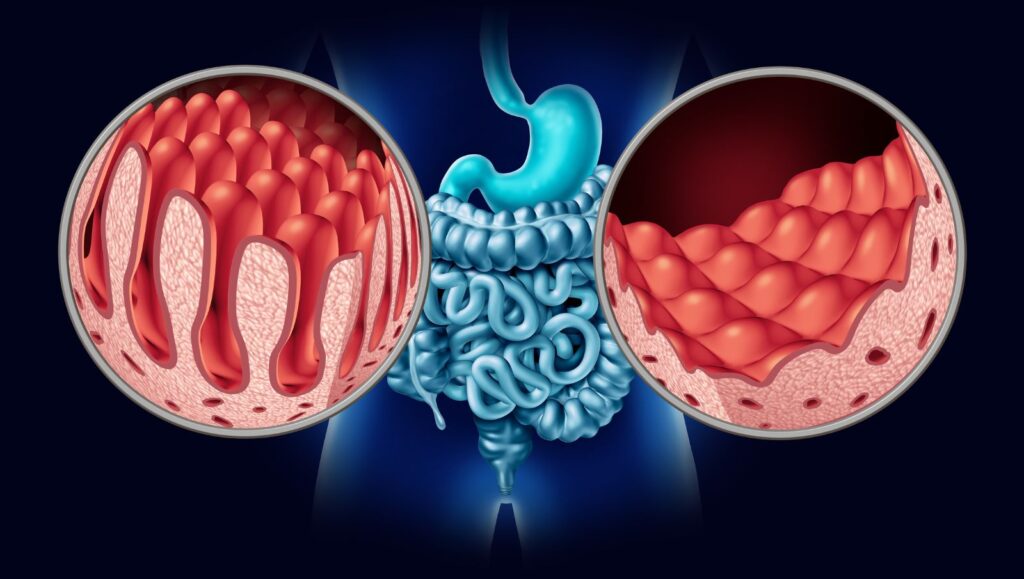
Crohn’s disease involves a dysregulated immune response toward commensal microbiota, leading to an inappropriate inflammatory cascade. This results in transmural damage to the intestinal lining, potentially causing severe complications such as strictures, fistulas, and abscesses [2]. The pathophysiology is chemically marked by elevated levels of pro-inflammatory cytokines, including TNF-α, and a fundamental disruption in the epithelial barrier which normally prevents bacterial translocation [6].
The Science: The Endocannabinoid System (ECS) and the Gut
The GI tract contains all relevant components of the ECS, which plays an essential role in maintaining gastrointestinal homeostasis and regulating the “brain-gut” axis [1].
- Mapping the Receptors: CB1 and CB2 receptors are found throughout the colonic epithelium and the enteric nervous system (ENS) [6]. CB1 receptors in the ENS act as a regulatory “brake” to protect against hyperstimulation, thereby reducing hypermotility and diarrhea [1, 2].
- Immune Modulation: Activation of CB2 receptors on immune cells – including T-cells, macrophages, and neutrophils – can induce apoptosis (programmed cell death) in overactive immune cells and reduce the recruitment of these cells to the inflamed colon [6].
- Barrier Function: Research suggests that cannabinoids help regulate epithelial permeability, potentially enhancing “wound closure” in the intestinal lining and preventing the translocation of bacteria into deeper tissues [1].
Clinical Research: What the Evidence Shows
Clinical interest in cannabis for Crohn’s has yielded promising observational and prospective data, focusing primarily on symptomatic remission and quality of life.
- Disease Activity Reduction: In a prospective study, treatment with THC-rich cannabis resulted in a significant decrease in the Crohn’s Disease Activity Index (CDAI) in 90% of patients [1, 6].
- Symptomatic Relief: Approximately 15% of IBD patients utilize cannabis specifically to alleviate diarrhea, abdominal pain, and loss of appetite [1, 4].
- Clinical Remission vs. Inflammation: While many patients achieve clinical remission (absence of symptoms), some studies indicate that inflammatory markers like C-reactive protein (CRP) may remain unchanged, suggesting that cannabinoids may manage the experience of the disease more effectively than the underlying pathology in some cases [4, 5].
Alabama Regulations: The Homestead Health Standard
Homestead Health ensures that Alabama residents with Crohn’s disease have access to safe, consistent, and laboratory-tested products under the strict oversight of the Alabama Medical Cannabis Commission (AMCC) [3, 5].
- Good Manufacturing Practices (GMP): All processing facilities must meet current GMP standards to ensure every dose is free from heavy metals, mold, and pesticides (Rule 538-X-6-.04) [5].
- Alabama’s Unique Flavor Mandate: Per state regulation, all medical cannabis gelatinous products (cubes) must be peach-flavored and non-sugar coated to deter pediatric ingestion [5].
- Pharmaceutical-Grade Forms: Alabama law permits non-combustible forms such as tablets, capsules, and tinctures, which are designed for precision dosing for chronic gastrointestinal conditions [3].
How to Qualify in Alabama for a Medical Cannabis Card
To qualify for a medical cannabis card in Alabama for Crohn’s Disease, patients must follow a regulated process [4, 7]:
Medical Diagnosis: A formal diagnosis of Crohn’s Disease with associated chronic abdominal pain, persistent diarrhea, and significant weight loss.
Physician Certification: Consultation with an Alabama physician registered with the Alabama Board of Medical Examiners (ALBME) who has completed the state-mandated training.
Treatment History: Documentation that conventional medical treatments (e.g., standard antiemetics or traditional pain medications) have failed or are contraindicated [4].
About Homestead Health
Homestead Health is more than a processor; we are a partner in the Alabama healthcare community. Our commitment to wellness and healthcare means we prioritize science over trends. We work within the strict bounds of Chapter 538-X-6 to ensure that our facilities meet the highest standards of the Alabama Administrative Code providing high quality, consistent, and laboratory tested medicine for Alabama residents.
Alabama Residents Living With Crohn’s Disease Also Ask
Yes. The AMCC officially lists Crohn’s disease as a qualifying condition. Patients must receive a formal diagnosis from a registered certifying physician [3].
While research shows potential for anti-inflammatory effects and significant symptomatic relief, it is not currently classified as a cure. It is used as a supplemental therapy to improve quality of life and manage flares [4].
Under Alabama law, patients can purchase tablets, capsules, tinctures, oils, and “gelatinous cuboids” (lozenges). Smoking, vaping, and traditional food-based edibles (like cookies) are strictly prohibited [5].
Potential drug-drug interactions exist, particularly with medications processed by the liver’s CYP450 enzyme system. Always discuss medical cannabis with your gastroenterologist to ensure it doesn’t interfere with your biologics [2].
The AMCC implemented a “universal flavor” rule to prevent medical products from being marketed as candy. Peach was selected as the standard flavor for all gelatinous cuboids and lozenges across the state [5].
Alabama law does not currently provide employment protections for medical cannabis patients. Employers retain the right to enforce drug-free workplace policies and may terminate employment based on a positive drug test [3, 5].
Patients must visit a physician registered with the Alabama Board of Medical Examiners (ALBME) who has completed the state-mandated training course. A directory is available on the AMCC and ALBME websites [3].
No. Under current state and federal law, health insurance providers and government programs like Medicaid are not required to cover or reimburse the cost of medical cannabis [3].
The following Alabama counties have been authorized as medical cannabis dispensing sites by the AMCC as of April 2026. Each site not only services county residents but also surrounding areas.
Note: A certification from any AMCC-registered physician in Alabama allows you to purchase at any licensed site in the state.
Baldwin County (Daphne)
Calhoun County (Oxford)
Cullman County (Cullman)
Etowah County (Attalla)
Jefferson County (Birmingham)
Limestone County (Athens)
Mobile County (Mobile)
Montgomery County (Montgomery)
Talladega County (Talladega)
Article References
Citations Used For This Article
- National Institutes of Health (NIH) / PubMed. Cannabis and Crohn’s Disease: A Review. https://pmc.ncbi.nlm.nih.gov/articles/PMC4076530/
- Expert Review of Gastroenterology & Hepatology. An overview of cannabis based treatment in Crohn’s disease. https://pubmed.ncbi.nlm.nih.gov/32149543/
- Alabama Medical Cannabis Commission (AMCC). Qualifying Conditions and Patient Registry. https://amcc.alabama.gov/
- Cochrane Library. Cannabis for the treatment of Crohn’s disease (Review). https://pmc.ncbi.nlm.nih.gov/articles/PMC6517156/
- Alabama Administrative Code. Chapter 538-X-6: Regulation of Processors and Product Standards. https://amcc.alabama.gov/rules/
- ClinicalTrials.gov / University of Jerusalem. Cytokine Production and CDAI Responses in IBD Patients. https://clinicaltrials.gov/study/NCT02828748